Soil conditions in Aylmer differ sharply from those in Hull. Aylmer sits on thick fluvial deposits of loose sand and silt. Hull has more glacial till over bedrock. That contrast makes vibrocompaction design essential in Gatineau for sites where loose granular soils need densification before building. We combine site data with numerical modeling to set compaction patterns, probe spacing, and energy requirements. Before finalizing the design, we often run a MASW survey to map stiffness variability across the site. This approach avoids over-compaction in stiff pockets and under-treatment in loose zones.
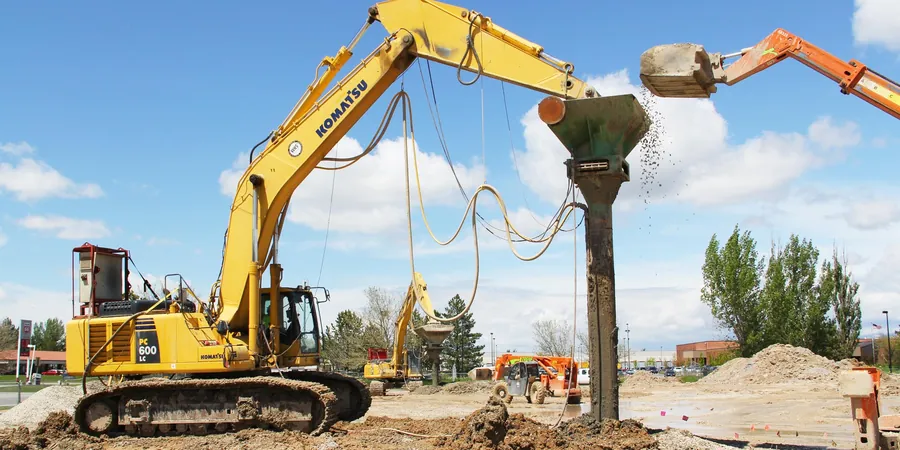
Typical vibrocompaction probe spacing in Gatineau loose sands ranges from 2.0 to 3.5 m, with energy inputs of 150–350 kWh per probe.
Scope of work in Gatineau
- Probe spacing: 2.0–3.5 m in triangular grid
- Energy per probe: 150–350 kWh
- Target relative density: 70–85 %
- Vibration frequency: 30–50 Hz
- Backfill material: clean sand or gravel
Demonstration video
Typical technical challenges in Gatineau
Gatineau experiences cold winters with freeze-thaw cycles that can alter near-surface soil density and moisture content. Vibrocompaction design must account for seasonal variations: saturated conditions after snowmelt reduce vibration transmission efficiency. In sectors like Plateau and Buckingham, organic layers or peat lenses can block vibration propagation. We mitigate this by pre-drilling through soft layers before inserting the vibrator. The shallow water table in the Hull sector also demands careful drainage design to avoid pore pressure build-up during compaction.
Our services
We deliver the full scope of vibrocompaction design for Gatineau projects, from initial feasibility to final quality control.
Site investigation for vibrocompaction
Boreholes, SPT, and CPT to map loose sand layers and groundwater conditions across the plot.
Numerical modeling of compaction pattern
Finite-element or empirical models to optimize probe spacing, energy, and sequence for target density.
Field trial and verification
Full-scale test section with before-and-after cone penetration tests to validate design assumptions.
Quality control and monitoring
Real-time vibration monitoring, settlement gauges, and post-treatment SPT/CPT to confirm relative density gains.
Frequently asked questions
What is the typical cost range for a vibrocompaction design study in Gatineau?
For a standard project, the design study ranges from CA$1,900 to CA$7,460 depending on site area, number of probes, and required field trials. Contact us for a project-specific quote.
How deep can vibrocompaction treat loose soils in Gatineau?
Typical treatment depths reach 8 to 15 m in clean sands. Deeper treatment is possible with high-energy vibrators, but the shallow water table in many Gatineau sectors limits maximum effective depth to about 15 m.
Can vibrocompaction be used in silty soils common in Gatineau?
Silty soils with more than 15% fines reduce vibration effectiveness. We recommend a feasibility study including grain size analysis and standard penetration tests before committing to vibrocompaction. In such cases, alternative methods like dynamic compaction or stone columns may be more suitable.
Does the design account for seismic site class under NBCC?
Yes. The design explicitly targets the required relative density to achieve the site class defined by NBCC 2020 for the project location in Gatineau. We verify with vs30/" data-interlink="1">shear wave velocity measurements post-treatment.