A 15-story condo tower on Boulevard des Allumettières needed a 22-meter-deep basement. The water table sits high near the Ottawa River. We designed a diaphragm wall system to cut off groundwater and support lateral loads from the adjacent road. Before finalizing the wall geometry, our team ran a [MASW survey](/masw-vs30/) to map the soil stiffness profile and a dilatometer test to measure in-situ horizontal stress. That data fed into the wall thickness calculations. The contractor saved three months of dewatering because the wall worked as a cut-off from day one.
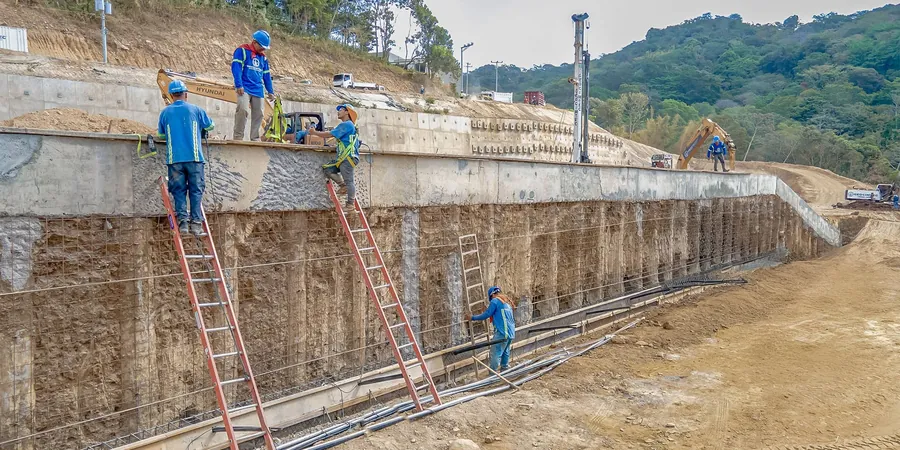
Champlain Sea clay can lose 50% of its strength within 24 hours of exposure. Diaphragm wall design must account for that sensitivity.
Scope of work in Gatineau
- Undrained shear strength (Cu) from field vane and triaxial tests
- Modulus of subgrade reaction (kh) for wall deflection limits
- Hydraulic conductivity (k) to confirm cut-off performance
- Lateral earth pressure coefficients at rest (K₀)
Typical technical challenges in Gatineau
A common mistake in Gatineau is assuming the clay behaves uniformly. Builders skip the panel joint design. Wet joints leak. One parking garage near Rue Principale had 40 cm of water in the basement after a spring thaw because the diaphragm wall panels were not keyed properly. The repair cost more than the original wall. We check joint water stops and concrete bleed paths before any pour. Sealing the wall at the toe into the underlying till layer is also non-negotiable. Without that seal, groundwater bypasses the wall entirely.
Our services
We provide end-to-end diaphragm wall design support in Gatineau, from soil characterization to construction monitoring.
Subsurface Investigation for Diaphragm Walls
Boreholes, SPT, field vane, and piezocone tests to define soil layering, strength, and groundwater conditions specific to the wall alignment.
Structural Wall Design & Detailing
Reinforced concrete design per CSA A23.3, including bending moment, shear capacity, crack width, and joint detailing for water tightness.
Construction Phase Support
Slurry testing, panel conformance checks, concrete sampling and strength verification, and post-excavation wall inspection.
Frequently asked questions
What is the typical depth range for diaphragm walls in Gatineau?
Most walls in Gatineau go between 15 and 30 meters deep, depending on the number of basement levels and the depth to competent till. Depths beyond 35 meters are rare but possible with careful slurry management.
How does Champlain Sea clay affect diaphragm wall design?
The clay is highly sensitive and can remold under excavation vibrations. We reduce panel lengths and increase slurry density to maintain trench stability. Long-term creep of the clay also requires higher reinforcement ratios to limit wall deflection over time.
Which testing standards do you follow for bentonite slurry?
We follow ASTM D4380 for density, D4381 for viscosity, and API 13B-1 for filtrate loss. The marsh funnel viscosity is kept between 32 and 40 seconds for Gatineau clays.
What is the cost range for diaphragm wall design in Gatineau?
The typical cost for design and geotechnical investigation in Gatineau ranges between CA$2.520 and CA$9.940, depending on wall length, depth, and number of soil borings required. Contact us for a quote tailored to your project.
Do you provide construction monitoring during wall installation?
Yes. Our team is on site for slurry testing, concrete sampling, reinforcement cage inspection, and panel conformance checks. We also monitor excavation lateral movements with inclinometers when required.