The surficial geology of Gatineau is dominated by post-glacial Champlain Sea sediments, primarily sensitive Leda clay that can lose up to 80% of its undrained shear strength upon remoulding. This quick clay behaviour, combined with a shallow bedrock profile in the Aylmer sector and deeper alluvial deposits along the Gatineau River, creates complex stability conditions for cut slopes and embankments. Our team integrates limit equilibrium and finite element methods using Spencer and Morgenstern-Price formulations to compute factor of safety under both static and pseudo-static seismic loads per NBCC 2020. For projects requiring detailed pore pressure data, we recommend pairing the analysis with monitoreo de excavaciones to track real-time groundwater response.
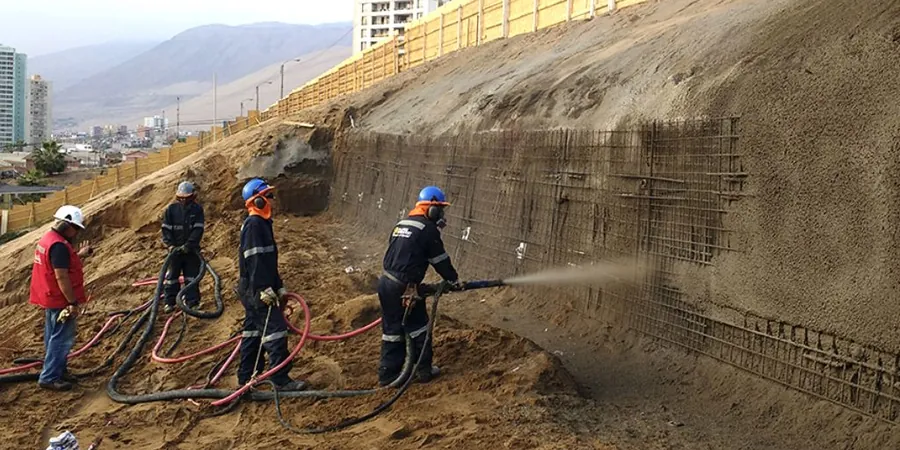
Gatineau's Leda clay can lose 80% of its undrained strength upon remoulding – a post-peak strain-softening behaviour that demands advanced numerical modelling.
Scope of work in Gatineau
- Limit equilibrium: Bishop simplified, Spencer, Morgenstern-Price, Janbu corrected
- FEM strength reduction: PLAXIS 2D with 15-node elements
- Seismic coefficient: NBCC 2020 PGA=0.4g for Gatineau zone
- Partial factors: CSA A23.3-19 for tieback anchors and shotcrete facing
Typical technical challenges in Gatineau
The contrast between the Hull sector's shallow bedrock overlain by 2-4 m of fill and the Plateau sector's 15+ m of soft Leda clay is the primary risk differentiator. In the Plateau, progressive failure mechanisms can develop along pre-existing fissure planes in the clay crust, especially after heavy rainfall or rapid drawdown along the Gatineau River. Our analyses incorporate strain-softening models to capture post-peak strength loss, and we use a 3D slope model to account for the end effects of narrow excavations. A factor of safety below 1.3 under static drained conditions triggers immediate redesign of the slope geometry or installation of soil nails and drainage blankets.
Our services
We provide complete slope stability investigation and design services for Gatineau's unique clay soils and bedrock slopes.
Limit Equilibrium & FEM Analysis
2D/3D limit equilibrium (Slide3) and finite element strength reduction (PLAXIS 2D) for cut slopes, embankments, and open excavations. We calibrate material models using site-specific laboratory data from our ISO 17025 accredited lab, including CU triaxial and direct simple shear tests. Deliverables include factor of safety contours, critical slip surfaces, and reinforcement force envelopes.
Remedial Design & Monitoring
Design of soil nail walls, tieback anchors, soldier piles, and drainage systems for slope stabilization. We specify instrumentation including inclinometers, piezometers, and shape-array cables to verify design assumptions during construction. Our monitoring program triggers automated alerts when displacement rates exceed 2 mm/day.
Frequently asked questions
What is the typical factor of safety required for a cut slope in Gatineau's Leda clay?
For long-term drained conditions, we design to a minimum factor of safety of 1.5 per FHWA guidelines. For short-term undrained conditions (e.g., end of construction), 1.3 is acceptable. Under pseudo-static seismic loads per NBCC 2020 (PGA=0.4g, site class C or D), the target is 1.1. These values account for the high sensitivity (St > 20) of the Champlain Sea clay.
How does the presence of quick clay affect slope stability in Gatineau?
Quick clay (sensitivity > 30) undergoes a dramatic loss of undrained shear strength when disturbed. In Gatineau's Plateau sector, a saturated Leda clay slope can drop from Su=50 kPa to 5 kPa upon remoulding, triggering a retrogressive landslide. Our analyses use strain-softening models (e.g., Tresca with post-peak degradation) to simulate this behaviour. We also recommend vane shear tests at 1 m intervals to map the sensitive zones.
What is the cost range for a slope stability study in Gatineau?
The cost typically ranges from CA$1.830 to CA$4.870 depending on the number of sections analyzed, complexity of the geology (e.g., presence of quick clay or shallow bedrock), and whether 3D FEM is required. This includes field reconnaissance, lab testing (triaxial + Atterberg), numerical modelling, and a report with reinforcement recommendations. Contact us for a precise quote based on your project scope.
How do you account for seismic loading in slope stability for Gatineau?
Gatineau lies in NBCC 2020 seismic zone with PGA=0.4g for a 2% in 50 years event. We apply a pseudo-static horizontal coefficient of 0.2g (one-half PGA) for the ULS check. For critical slopes (e.g., adjacent to schools or highways), we perform a Newmark sliding block analysis to compute permanent displacements. We also check liquefaction potential in the underlying sands using the NCEER (Youd-Idriss 2001) method.