We see it often: contractors in Gatineau assume the old asphalt is strong enough and overlay directly, only to crack within two winters. The freeze-thaw cycles here, combined with the sensitive Champlain Sea clay that underlies much of the city, create a subgrade that can lose bearing capacity rapidly. A proper existing pavement evaluation before rehabilitation saves money by identifying weak spots, measuring layer thicknesses, and checking drainage conditions. We combine coring with a georradar GPR survey to map subsurface anomalies without digging up every section, and we always correlate results with the capacidad de carga of the underlying soil to avoid structural surprises.
In Gatineau, a 150 mm core often reveals that the old base course is saturated, reducing its modulus by half compared to dry conditions.
Scope of work in Gatineau
Typical technical challenges in Gatineau
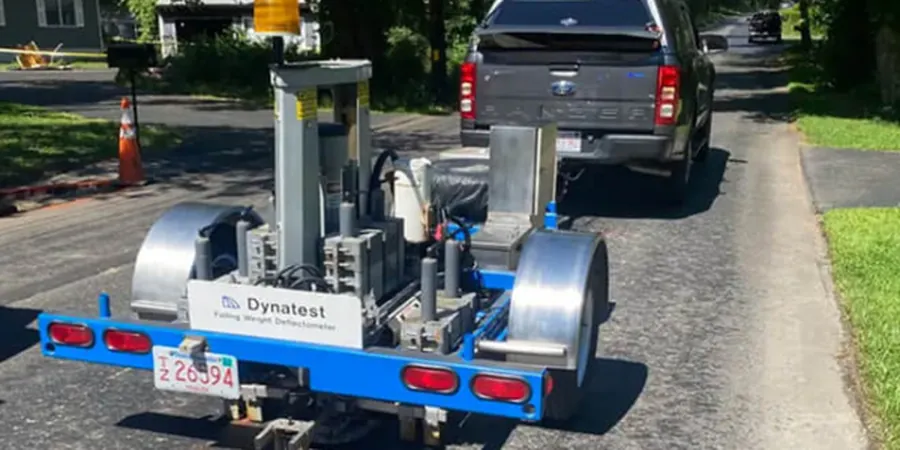
The falling weight deflectometer we use in Gatineau is a trailer-mounted unit that drops a 40 kN load onto a 300 mm plate, measuring deflection with seven geophones. If the subgrade is saturated from spring thaw, the deflection basin can triple, indicating a structural deficiency that an overlay alone cannot fix. We also encounter risk from frost heave in the till layers, which creates differential heaving that cracks the pavement longitudinally. Our evaluation identifies these zones before you commit to a rehabilitation strategy, allowing you to plan for drainage improvements or even full-depth reclamation where the Leda clay is too weak to support additional weight.
Our services
We offer three core services for existing pavement evaluation in Gatineau, each tailored to the local geology and climate.
Visual Distress & Core Survey
Systematic crack mapping and core extraction at 200 m stations. We measure asphalt thickness, record alligator cracking, rut depth, and edge ravelling. Each core is logged for layer composition and photographed for the report.
FWD Deflection Testing
Falling weight deflectometer testing at 50 m intervals with 40 kN drop load. We back-calculate the effective modulus of each layer and identify weak subgrade pockets that need full-depth repair before overlay.
Subgrade Sampling & Lab Characterization
Bulk samples from core holes or test pits at representative locations. We perform CBR, Atterberg limits, grain size, and resilient modulus testing to provide the data needed for mechanistic-empirical overlay design per AASHTOWare.
Frequently asked questions
What does an existing pavement evaluation include in Gatineau?
A typical evaluation covers visual distress mapping, core extraction at 200 m intervals, FWD deflection testing, and laboratory testing of subgrade samples. We also check drainage conditions and review any previous pavement records. The final report gives you layer thicknesses, material properties, and recommended rehabilitation options.
How much does an existing pavement evaluation cost in Gatineau?
For a standard 1 km section with cores every 200 m and FWD at 50 m, the cost ranges between CA$1.690 and CA$5.080 depending on site access, number of cores, and lab tests required. We provide a fixed quote after a site visit to confirm the scope.
Why is FWD testing important for Gatineau pavements?
Gatineau's Leda clay loses strength when wet, and FWD testing measures the actual in-situ deflection under load. This tells you if the subgrade is too weak to support an overlay. Without FWD data, you risk placing new asphalt over a failed base, which cracks within one freeze-thaw cycle.
Can you evaluate a parking lot or small driveway in Gatineau?
Yes, we handle projects of all sizes. For small areas we use a portable FWD unit and take hand-auger subgrade samples. The evaluation approach is the same: identify weak zones, measure layer thickness, and recommend a cost-effective repair strategy.