Gatineau sits at an elevation of about 60 meters above sea level, with the Ottawa River shaping its subsurface geology. The region's glacial and post-glacial deposits create variable bearing conditions across neighborhoods. A bearing capacity analysis is essential for designing safe foundations. The team uses in-situ testing and lab data to determine allowable pressures. Before pouring concrete, we often recommend a compression simple test on undisturbed samples to confirm strength parameters. This step prevents costly overdesign or structural settlement.
Gatineau's Champlain Sea clay can reduce allowable bearing capacity to below 50 kPa — a critical factor for foundation design.
Scope of work in Gatineau
Typical technical challenges in Gatineau
Gatineau expanded rapidly after the 1970s, pushing development into areas underlain by sensitive marine clay. Many subdivisions now sit on compressible soils that respond poorly to heavy loads. Without a bearing capacity analysis, structures risk excessive settlement or foundation rotation. This is especially true near the Ottawa River floodplain. The team has seen cases where strip footings settled over 10 cm within two years. A thorough analysis identifies these hazards early and allows for engineered solutions like deep foundations or soil improvement.
Our services
We offer three complementary services to complete your bearing capacity analysis in Gatineau.
Plate Load Testing
Field plate load tests measure soil deformation under controlled loads. We use circular plates up to 762 mm diameter and apply loads incrementally. Results provide a direct bearing capacity value for shallow foundation design.
Cone Penetration Testing (CPT)
CPT offers continuous soil profiling and tip resistance data. It helps identify soft clay layers and estimate bearing capacity for deep foundations. The method is fast and reduces the need for multiple boreholes.
Laboratory Triaxial Testing
Undrained and consolidated triaxial tests on undisturbed samples provide shear strength parameters for bearing capacity calculations. We follow CSA + CSA + CSA + CSA + ASTM D2850 (also CFEM Ch 2) (also CFEM Ch 2) (also CFEM Ch 2) (also CFEM Ch 2) (also CFEM Ch 2) for UU tests and ASTM D4767 for CU tests.
Frequently asked questions
How does bearing capacity analysis differ from a standard soil test?
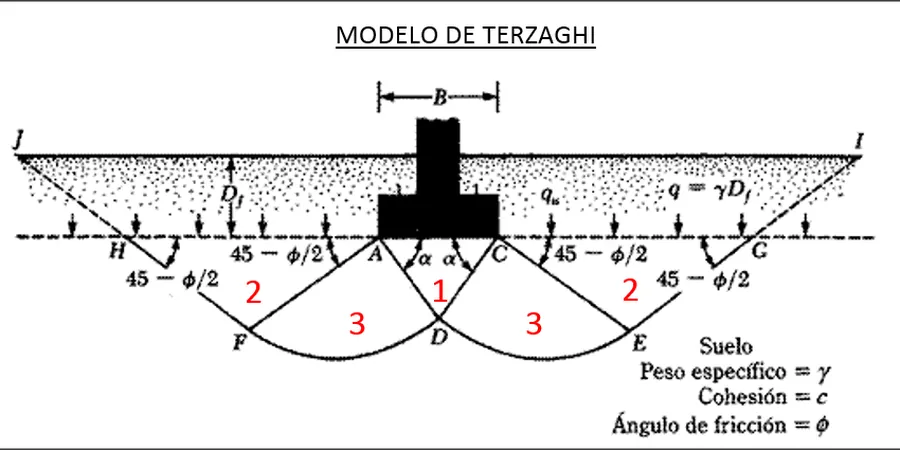
A standard soil test identifies soil type and basic properties. Bearing capacity analysis calculates the maximum load the soil can support safely. It applies specific failure theories like Terzaghi or Meyerhof and uses the results to size foundations.
What is the typical cost range for a bearing capacity analysis in Gatineau?
The range for a residential lot analysis is between CA$950 and CA$2,560. Commercial projects with multiple test points fall at the higher end. Final cost depends on site access, depth of testing, and number of samples.
Can bearing capacity change with seasonal frost in Gatineau?
Yes. Frost penetration can temporarily increase soil stiffness, but thawing reduces strength. The analysis accounts for worst-case conditions, including thawed soil in spring. NBCC requires foundation depths below frost line, typically 1.8 m in Gatineau.
Do I need a separate bearing capacity analysis for a crawl space vs a basement?
The reference range for this service in Gatineau is CA$950 - CA$2.560. The final price depends on the project scope and volume.