Gatineau sits on a thick sequence of Champlain Sea clay, a sensitive marine deposit that can lose strength dramatically when disturbed. We have seen this firsthand on projects near the Ottawa River, where excavation for basements or retaining walls must account for a water table sitting only 1.5 to 3 meters below grade. Before any retaining wall design begins, we run a proper site investigation that includes borehole drilling and SPT testing to profile the clay crust, the soft layer underneath, and any granular pockets left by ancient river channels. That data drives the wall type, drainage requirements, and the overall stability check.
In Gatineau, the Champlain Sea clay can lose 50% of its strength when sheared undrained under seismic loading — your retaining wall must account for that.
Scope of work in Gatineau
- Site classification per NBCC Table 4.1.8.4.A — usually site class D or E for the soft clay.
- Select wall type: cantilever, gravity, or anchored depending on height and space constraints.
- Calculate active and passive earth pressures using Rankine or Coulomb theory, then apply seismic increment per Seed & Whitman (1970).
- Check global stability with a limit-equilibrium method — Bishop simplified or Spencer for non-circular slip surfaces.
Typical technical challenges in Gatineau
Gatineau expanded rapidly from the 1960s onward, with many subdivisions built over soft clay without thorough ground improvement. The consequence shows up decades later: retaining walls built on untreated clay often experience differential settlement, wall rotation, or even collapse during wet springs. We documented one case near the Galeries de Hull where a 3-m cantilever wall tilted 150 mm after heavy rainfall, because the drainage blanket was undersized. For new retaining wall design in Gatineau, we recommend at least a 0.5-m gravel drain behind the wall, connected to a perforated pipe daylighting beyond the wall toe. Ignoring the clay's sensitivity and the high water table is the fastest way to see a wall fail within five years.
Our services
We deliver complete retaining wall design services tailored to Gatineau's ground conditions, from concept through construction support.
Gravity & Cantilever Walls
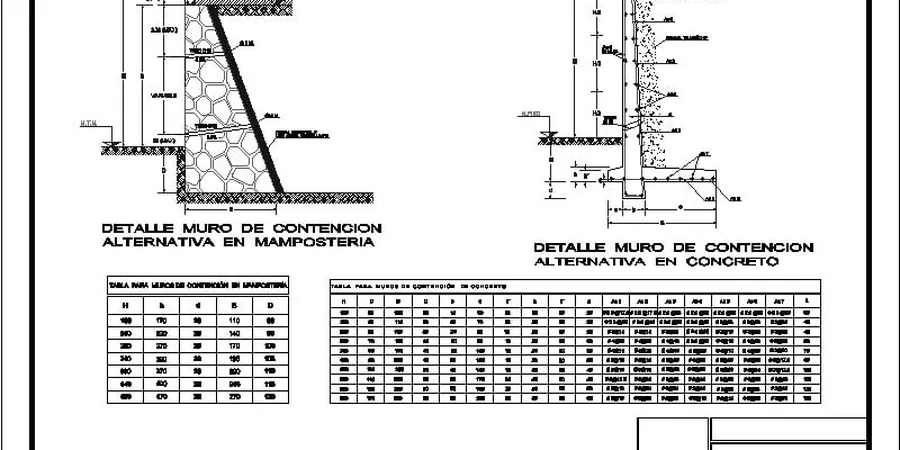
Design of reinforced concrete or masonry cantilever walls for heights up to 6 m, including sliding, overturning, and bearing checks per NBCC.
Anchored & Tied-Back Walls
For taller walls or constrained sites, we design anchored systems with post-tensioned tendons, grouted in bedrock or dense till, verified by proof testing.
Mechanically Stabilized Earth (MSE) Walls
MSE walls with geogrid or steel strips, designed per AASHTO LRFD for embankments and bridge approaches in Gatineau's clay environment.
Frequently asked questions
What is the typical cost range for retaining wall design in Gatineau?
The fee for a professional retaining wall design in Gatineau typically falls between CA$1.490 and CA$6.030, depending on wall height, site complexity, and the amount of geotechnical investigation required. A simple 2-m cantilever wall on a well-drained site will be at the lower end, whereas an anchored wall over soft clay with seismic analysis will reach the upper range.
How deep should a retaining wall foundation be in Gatineau to avoid frost heave?
Per NBCC Table B-1, the frost depth in Gatineau is 1.8 m. We design wall footings to bear at least 1.8 m below final grade, or we use a frost-protected shallow foundation with rigid insulation if depth is limited. The Champlain Sea clay is highly frost-susceptible, so a gravel drainage layer and a capillary break are also mandatory to prevent ice lens formation behind the wall.
Do I need a seismic analysis for a retaining wall in Gatineau?
Yes. Gatineau is in seismic zone 4 with a PGA of 0.32g per NBCC 2020. Any retaining wall higher than 1.5 m and supporting a slope or surcharge load should include a pseudo-static seismic check. We apply a horizontal seismic coefficient of 0.15 to 0.25 and verify that the wall does not slide or overturn under combined static and seismic forces. The soft clay amplifies ground motion, so ignoring seismic loading can lead to sudden failure during an earthquake.