The unconfined compression test (UCS) per ASTM D2166 is the standard method for measuring the undrained shear strength of saturated cohesive soils in Gatineau. Given the region's extensive deposits of Leda clay — a sensitive marine clay that can lose strength rapidly under load — UCS results are critical for foundation design and slope stability assessments. Before interpreting these values, engineers often combine them with an ensayo triaxial to evaluate effective stress parameters under drained conditions. The laboratory follows ISO 17025 protocols to ensure repeatability and traceability of every UCS result.
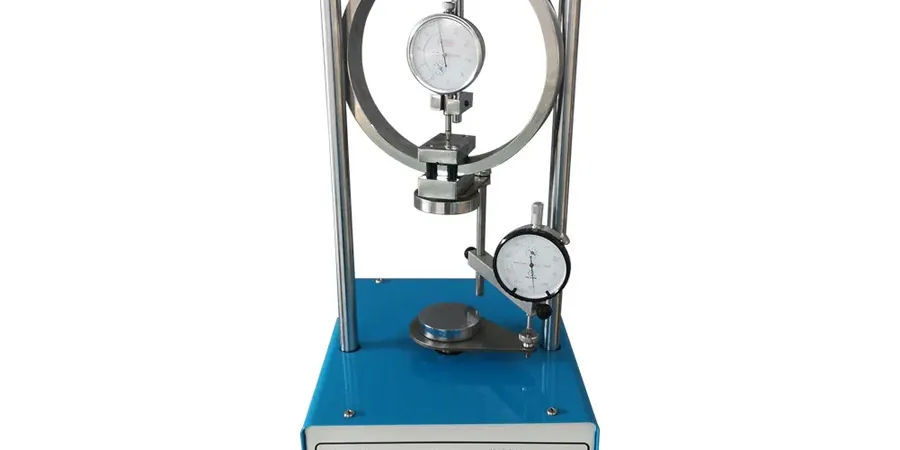
Sensitive Leda clay in Gatineau typically fails at axial strains of 2% to 6%, highlighting brittle behavior under undrained loading.
Scope of work in Gatineau
- Specimen trimming from undisturbed Shelby tube samples
- Axial loading at a constant strain rate of 0.5% to 2% per minute
- Recording peak stress and axial strain at failure
Typical technical challenges in Gatineau
A common mistake in Gatineau construction projects is relying solely on empirical correlations for clay strength without site-specific UCS testing. Local Leda clay exhibits high sensitivity (St > 10), meaning its remolded strength can be a fraction of the intact strength. Specimens must be handled with extreme care to avoid disturbance; even minor vibration during transport can reduce measured qu by 30% or more. The engineering team emphasizes that undisturbed sampling per ASTM D1587 is non-negotiable for reliable UCS results in this region.
Our services
The laboratory offers complete UCS testing support for Gatineau projects, from sampling to reporting.
Undisturbed Sampling for UCS
Thin-walled Shelby tube sampling per ASTM D1587, with careful sealing and transport to preserve in-situ moisture and fabric. Critical for Leda clay integrity.
Unconfined Compression Testing
Full ASTM D2166 procedure with automated load frames, continuous axial strain measurement, and stress-strain curve reporting. Results include qu, Su, and failure strain.
Data Interpretation & Reporting
Detailed report correlating UCS results with local geotechnical context, including sensitivity assessment (St) and recommendations for foundation bearing capacity or slope stability.
Frequently asked questions
What is the unconfined compression test (UCS) used for in Gatineau?
UCS measures the undrained shear strength of cohesive soils like Leda clay. It is used for foundation bearing capacity calculations, slope stability analysis, and quality control of earthworks. Results are expressed as qu (unconfined compressive strength) and Su (undrained shear strength = qu/2).
How much does an unconfined compression test cost in Gatineau?
The typical cost for a single UCS test in Gatineau ranges from CA$420 to CA$720, depending on sample condition, number of specimens, and reporting detail. Volume discounts apply for multiple samples from the same project.
What sample quality is required for UCS testing on Gatineau clay?
Specimens must be undisturbed, taken with thin-walled Shelby tubes (ASTM D1587). The height-to-diameter ratio should be between 2.0 and 2.5. Samples must not be allowed to dry or freeze during transport. Disturbed samples produce unreliable low strength values.
How do UCS results compare with field vane shear tests in Gatineau?
UCS tends to give slightly lower undrained shear strength than field vane tests for sensitive Leda clay, due to sample disturbance during extraction and handling. A correction factor of 0.8 to 0.9 is often applied to field vane results for design. Both methods are complementary.