A new residential development near the Gatineau River required a stable working platform over soft Champlain Sea clay. The contractor brought in a geocell design to distribute construction loads across the low-bearing-capacity subgrade, preventing rutting and differential settlement. Geocell confinement systems create a three-dimensional cellular structure that locks granular fill in place, effectively increasing the bearing capacity of the weak soil. For Gatineau projects, this approach is particularly valuable given the region's widespread sensitive marine clays, which can lose strength rapidly under repeated loading. The geocell design used a 200 mm tall cell with a welded-on textured geotextile base to provide separation and drainage.
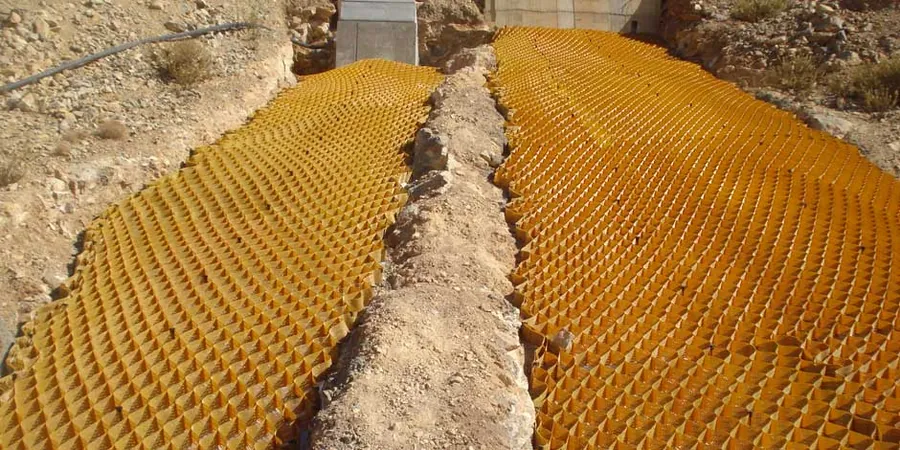
Geocell confinement in Gatineau's sensitive clays can increase the effective bearing capacity by 2 to 3 times while reducing total settlement by up to 40%.
Scope of work in Gatineau
Typical technical challenges in Gatineau
An excavator spreads gravel over the expanded geocell mat on a Gatineau construction site, where the underlying clay can squeeze upward between cells if the infill is placed too fast. The main risk in geocell design for Gatineau is inadequate confinement of the infill material, leading to lateral bulging and loss of bearing capacity. On steep slopes near the Gatineau River, a geocell system must also resist sliding along the clay-geocell interface. A proper anchorage at the crest and a drainage layer beneath the geocell prevent hydrostatic uplift during spring thaw.
Our services
We provide comprehensive geocell design services tailored to Gatineau's ground conditions, from preliminary analysis through installation support.
Load Support Platform Design
Geocell configuration for temporary and permanent access roads, crane pads, and laydown areas on soft Gatineau clay.
Slope Stabilization with Geocells
Design of geocell-reinforced slopes along the Gatineau River escarpment and highway embankments, including anchor trench and drainage details.
Retaining Wall and MSE Structure Integration
Combined geocell and mechanically stabilized earth (MSE) walls for residential subdivisions in the Aylmer sector.
Basal Reinforcement for Embankments
Geocell mattress design beneath road and rail embankments on deep soft clay deposits, with settlement and stability analysis.
Frequently asked questions
What is the typical cost range for a geocell design in Gatineau?
For a standard 500-1000 m² platform, the geocell design and material supply ranges between CA$1.290 and CA$2.970, excluding fill and installation. Larger volumes reduce the unit cost.
How does geocell design differ for Gatineau's Champlain Sea clay compared to other soils?
Champlain Sea clay is highly sensitive and can lose 50-80% of its undrained shear strength when disturbed. The geocell design must limit subgrade stress to less than 50% of the remolded shear strength, and include a separation geotextile to prevent clay infiltration into the granular infill.
Can geocells be used for slope repair along the Gatineau River?
Yes, geocell systems are effective for repairing shallow slope failures up to 3:1 (H:V). The cells must be anchored at the crest with steel pins or ground anchors, and a filter layer provided at the base to prevent internal erosion of the clay.
What is the design life of a geocell system in Gatineau's climate?
With a minimum 2% carbon black content and UV-stabilized HDPE, geocells have a service life exceeding 50 years when buried. For exposed applications, a cover of 150 mm of fill or a protective cap is required to prevent UV degradation.
Does a geocell design require a site-specific geotechnical investigation?
Absolutely. A borehole or test pit is needed to determine the clay's undrained shear strength, sensitivity, and water content. Without these parameters, the geocell design cannot verify bearing capacity or settlement limits per NBCC 2020.