Gatineau sits on a mix of Champlain Sea clay and glacial till, with over 270,000 residents spread across the Ottawa River valley. The soft marine clay found in sectors like Hull and Aylmer often requires chemical stabilization before construction can proceed. Lime and cement stabilization modifies the engineering properties of these fine-grained soils, reducing plasticity index and increasing bearing capacity. Before designing the mix, a thorough study of soil mechanics is essential to determine the natural moisture content and clay mineralogy. The treatment targets subgrades and foundation layers where the native material fails to meet minimum structural requirements under NBCC 2020.
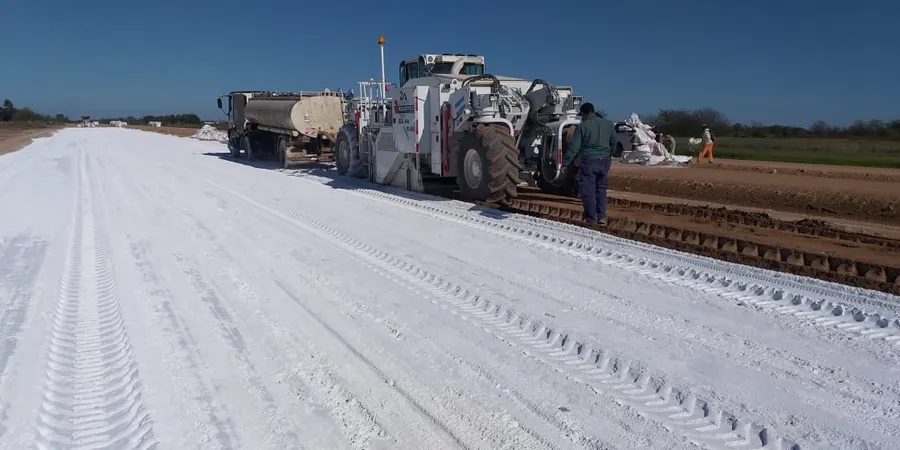
Champlain Sea clay in Gatineau typically shows a natural moisture content exceeding the liquid limit, making lime stabilization the first step before any cement addition.
Scope of work in Gatineau
Typical technical challenges in Gatineau
The mixing crew mobilizes a self-propelled reclaimer-stabilizer that cuts 0.5 m deep in a single pass. In Gatineau, the risk of delayed compaction due to rainfall is significant — treated soil must be compacted within 2 hours of mixing to prevent the cement from hydrating prematurely. Another concern is the formation of ettringite in sulfate-rich ground, which can cause heave years later. A preliminary sulfate test should be run on every batch to avoid long-term swelling. The operational sequence requires continuous moisture monitoring; if the mix dries too fast, surface cracking reduces the treatment effectiveness.
Our services
We provide three specialized stabilization services tailored to Gatineau's soil conditions and project requirements.
Lime Stabilization for Plastic Clays
Treatment of high-plasticity Champlain clays with hydrated lime to reduce Atterberg limits and improve workability. Application rates are determined by the Eades-Grimm pH test per ASTM D6276.
Cement Stabilization for Subgrades
Portland cement mixed at 4-8% by dry weight to achieve a target unconfined compressive strength of 300 kPa at 7 days. Suitable for road bases and light foundation pads in Gatineau.
Lime-Cement Combined Treatment
Two-stage stabilization: lime first to modify the clay, then cement to add strength. Used where the natural moisture content exceeds 70% and a single agent is insufficient.
Frequently asked questions
How much does lime and cement stabilization cost in Gatineau?
The typical cost range for chemical stabilization in Gatineau is CA$1.140 to CA$3.050 per project, depending on the treatment depth, total volume, and the type of stabilizer. A detailed quote is provided after the soil test results are known.
How long does the stabilized soil take to cure before loading?
Lime-treated soils require a minimum 7-day curing period before any construction load is applied. Cement-stabilized sections can often be trafficked after 3 days, but full strength development takes 28 days. Cold weather in Gatineau extends the curing time significantly.
Is lime stabilization effective on the sensitive marine clays found in Gatineau?
Yes, it is one of the most effective treatments for Champlain Sea clay. The lime reacts with the montmorillonite and illite minerals to reduce plasticity and increase workability. A laboratory mix design is always recommended to optimize the lime content for the specific clay batch.