The National Building Code of Canada (NBCC 2020) demands that loose fill and soft soil deposits be densified to mitigate excessive total and differential settlements. In Gatineau, where glacio-marine clay (Champlain Sea) overlays sand and gravel terraces, dynamic compaction design must account for both the energy transfer through a saturated crust and the risk of pore pressure build-up in deeper clay lenses. Before starting a dynamic compaction program in Gatineau, it is standard practice to run a MASW-Vs30 survey to map stiffness profiles at depth, and to use plate load testing to verify modulus improvement after each pass. Without these preliminary steps, the design energy per blow cannot be calibrated for local soil conditions.
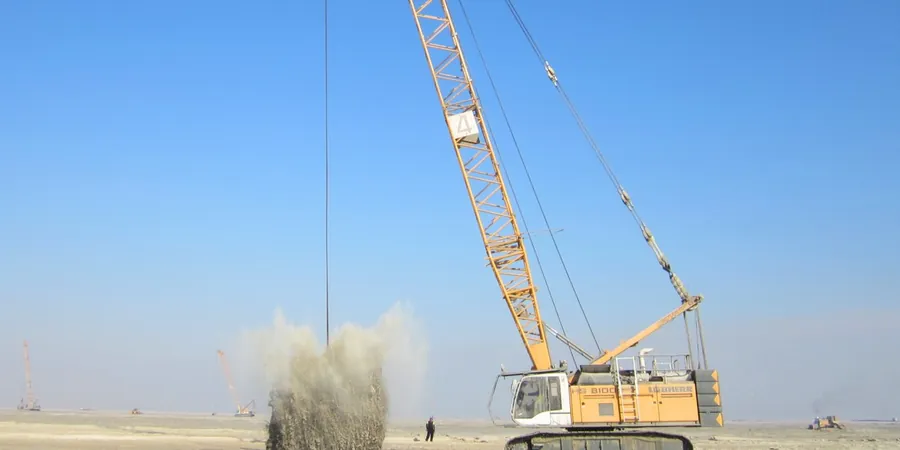
In Champlain Sea clay terrain, dynamic compaction must be designed to avoid punching failure – correct energy per drop is critical.
Scope of work in Gatineau
Typical technical challenges in Gatineau
A common mistake in Gatineau is applying a single energy level across an entire site without zoning by soil type. The Champlain Sea clay acts as a energy-absorbing cushion; if the tamper energy is too low, the improvement zone stays shallow. Conversely, too much energy on a thin fill over soft clay can cause punching failure and shear rupture in the underlying clay layer. Another frequent error is ignoring pore water pressure dissipation time between passes. In Gatineau’s high water table conditions, waiting at least 7–14 days between passes is necessary to avoid liquefaction of the treated layer during the next impact.
Our services
We offer a full dynamic compaction design package for Gatineau, from initial site investigation to post-treatment verification.
Site Characterization & Zoning
Geophysical surveys (MASW, GPR) and boreholes to map fill thickness, clay crust depth, and groundwater regime.
Energy Design & Grid Layout
Calculation of tamper weight, drop height, and grid spacing based on target density and settlement criteria.
Pore Pressure Monitoring
Installation of piezometers to track dissipation rates and avoid hydraulic fracturing during compaction.
Post-Treatment Verification
SPT, CPT, and plate load tests after each pass to confirm relative density and modulus improvement.
Frequently asked questions
How does dynamic compaction differ from vibro-compaction in Gatineau's soils?
Dynamic compaction uses high-energy impact from a falling tamper to densify deep granular fills, reaching depths of 8–12 m. Vibro-compaction uses a vibrating probe to rearrange particles in saturated sands, typically shallower. In Gatineau, dynamic compaction is preferred for thick fills over clay, while vibro-compaction works better in clean sand deposits with low fines content.
What is the typical cost range for dynamic compaction design in Gatineau?
The typical cost range for dynamic compaction design in Gatineau is CA$1.650 – CA$5.080, depending on site area, number of passes, and verification testing required. Larger sites with multiple zones may fall at the higher end of this range.
How long does a dynamic compaction project take in Gatineau?
A typical project lasts 4–8 weeks, including site investigation (1 week), two to three compaction passes (2–4 weeks), and post-treatment verification (1 week). Waiting periods for pore pressure dissipation add 7–14 days between passes in high water table conditions.
Can dynamic compaction be used on fine-grained soils like Champlain Sea clay?
Dynamic compaction is effective primarily on granular fills. For the underlying Champlain Sea clay, it can densify the crust but not the deep sensitive clay. In such cases, ground improvement techniques like stone columns or wick drains are combined with dynamic compaction to accelerate consolidation in the clay layer.
What post-treatment tests confirm improvement after dynamic compaction?
Standard verification includes SPT (CSA A23.2-9A / CSA A23.2-9A / CSA A23.2-9A / CSA A23.2-9A / CSA A23.2-9A / ASTM D1586) to measure blow count increase, CPT to assess cone resistance, and plate load tests (ASTM D1194) to determine modulus of subgrade reaction. Geophysical surveys like MASW are repeated to confirm shear wave velocity improvement.