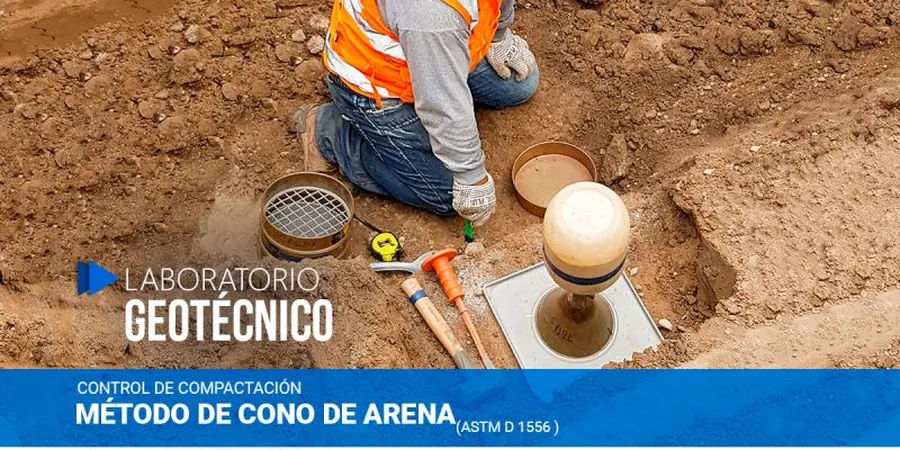
The sand cone apparatus sits on a freshly excavated hole in Gatineau’s compacted fill. A technician levels the base plate, pours calibrated sand from the jar, and measures the volume with precision. This field density test (sand cone method) determines in-situ dry unit weight and moisture content. It is the standard for compaction control on granular fills and subgrades across the city. Before mobilizing the cone, the team verifies sand calibration against a known density. The procedure follows ASTM D1556-16, ensuring repeatable results. For projects requiring deeper profiles, the crew often pairs this with an ensayo SPT to correlate blow counts with relative density. The test takes about 30 minutes per location.
In Gatineau’s marine clay zones, density alone is not enough — shear strength data from vane tests completes the picture.
Scope of work in Gatineau
- Dry density (kg/m³)
- Moisture content (%)
- Relative compaction (%)
- Sand cone calibration factor
Demonstration video
Typical technical challenges in Gatineau
The Champlain Sea clay that underlies much of Gatineau is highly sensitive. When compacted at moisture contents above optimum, these soils lose strength and settle over decades. Field density test (sand cone method) detects compaction deficiencies before they become differential settlement issues. The Ottawa River floodplain adds another risk: seasonal water table rise can saturate granular fills, reducing bearing capacity. In areas like Plateau or Hull, old organic deposits beneath fills can go unnoticed without density control. A single low-density reading triggers re-compaction, saving the structure from future cracking.
Our services
Complementary services for compaction control in Gatineau include:
Nuclear Density Gauge Calibration
Calibration verification of Troxler and CPN gauges against sand cone results. Annual traceability to NRC standards.
Moisture-Density Relationship (Proctor)
Modified Proctor tests (ASTM D1557 (also CFEM Ch 2) (also CFEM Ch 2) (also CFEM Ch 2) (also CFEM Ch 2) (also CFEM Ch 2)) on local Gatineau soils to establish target dry density and optimum moisture for compaction.
Compaction Test Reports
Certified reports with relative compaction, moisture content, and field notes. Signed by a professional engineer registered in Quebec.
Frequently asked questions
How does the sand cone method work in Gatineau's clay soils?
In clayey fills, the sand cone test is limited to granular layers above the clay. For clay itself, the team uses a vane shear test to measure undrained strength. Sand cone works well on sand and gravel subgrades common in Gatineau's new subdivisions.
What is the cost of a field density test in Gatineau?
The typical range is CA$120 to CA$190 per test point. Volume discounts apply for projects with more than 20 points. Price includes sand, calibration, and a certified report.
How many sand cone tests are needed per lift?
NBCC 2020 recommends one test per 200 m² of compacted area per lift. For critical fills near foundations, frequency increases to one test per 100 m². The engineer of record defines the final frequency.
Can the sand cone method be used on wet fills?
Yes, but moisture content above the optimum reduces relative compaction. The test still measures dry density accurately. If water is present on the surface, the technician waits for drainage or uses a nuclear gauge instead.