The contrast between the alluvial flats along the Ottawa River in Hull and the till-covered bedrock rises near Aylmer tells an immediate story about Gatineau’s variable subsurface. In one block you might encounter soft, compressible silts requiring wider footings, while a few kilometres north the challenge shifts to shallow rock that demands controlled excavation. That is precisely why shallow foundation design in Gatineau cannot rely on a one-size-fits-all table. Each site needs a bespoke interpretation of soil stiffness, groundwater depth, and frost penetration. Before casting a single footing, we complement our analysis with a placa de carga test to verify modulus of subgrade reaction, especially in those transition zones between organic layers and glacial till. The foundation must work with the ground, not against it.
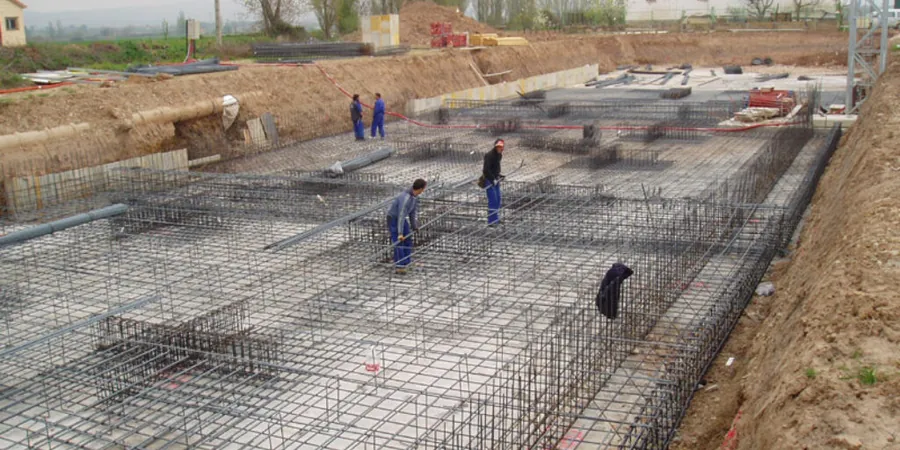
A one-size-fits-all table fails when the soil changes from alluvial silt to glacial till within a single street block.
Scope of work in Gatineau
- Bearing capacity under drained and undrained conditions
- Estimated total and differential settlement (typically within 25 mm for strip footings)
- Frost heave potential based on fines content and groundwater level
- Seismic bearing capacity and sliding resistance per CSA A23.3-19
Typical technical challenges in Gatineau
A common oversight we see among local builders is assuming that the stiff crust of desiccated clay—often present in the Plateau and Mont-Laurier areas—represents the bearing stratum. Once excavation begins, the underlying soft, sensitive clay (Leda clay in some pockets) can reduce the effective bearing capacity by half. Relying on surface observations without a proper investigation leads to differential settlements that crack walls and jam doors within the first winter cycle. Shallow foundation design in Gatineau must penetrate through that deceptive crust and confirm the properties of the actual load-bearing layer at depth. Skipping this step turns a minor saving into a structural headache.
Our services
We provide two complementary services that cover the full scope of shallow foundation design in Gatineau, from field investigation to structural sizing.
Geotechnical Investigation for Shallow Foundations
Boreholes advanced to 6–10 m depth with SPT sampling, undisturbed tube sampling for sensitive clays, and laboratory testing (triaxial, consolidation, Atterberg limits). We deliver a foundation recommendation report with allowable bearing capacity, settlement estimates, and site class per NBCC 2020.
Shallow Foundation Sizing & Detailing
Structural design of strip footings, spread footings, and mat slabs in accordance with CSA A23.3-19. We integrate the geotechnical parameters into a limit-state design, considering frost heave, groundwater buoyancy, and seismic overturning. Drawings and reinforcement schedules are included.
Frequently asked questions
What is the typical cost for a shallow foundation design study in Gatineau?
For a standard residential or small commercial project in Gatineau, the cost ranges between CA$2.440 and CA$3.780, depending on the number of boreholes, required laboratory tests, and the complexity of the soil profile. This includes field work, lab analysis, and a final report with bearing capacity and settlement calculations.
How deep should a shallow foundation be in Gatineau to avoid frost heave?
The minimum frost depth for Gatineau is 1.8 m below finished grade, based on the NBCC 2020 frost penetration map for the Ottawa Valley. Footings placed shallower than that require frost-protection measures such as rigid insulation or non-frost-susceptible backfill. In areas with silty soils and high water table, we recommend going deeper or adding a gravel raft.
What soil conditions in Gatineau require a shallow foundation to be oversized?
Sites underlain by soft Leda clay or compressible organic silts—common near the Gatineau River floodplain and areas around Parc de la Gatineau—often require wider footings or a mat foundation to keep bearing pressures below 80–120 kPa. An oversized footing spreads the load and limits differential settlement in these sensitive materials.
Is shallow foundation design in Gatineau affected by seismic requirements?
Yes, Gatineau falls in a moderate seismic zone. The NBCC 2020 requires site-specific spectral acceleration values and a site class determination. If the soil profile includes soft clay layers with Vs30 below 350 m/s, the foundation must be designed for amplified seismic forces and potential liquefaction in loose sands. We incorporate these factors into the footing width and reinforcement details.