Gatineau sits on the Ottawa-Bonnechere Graben, where the bedrock depth varies dramatically from less than 2 meters in the Aylmer sector to over 30 meters of soft Champlain Sea clay in the Hull district. This geological contrast makes shear wave velocity profiling essential for seismic design. Our MASW surveys directly measure VS30 — the average shear wave velocity in the upper 30 meters — providing the site class required by the National Building Code of Canada. Before proceeding with detailed foundation design, many projects benefit from integrating MASW results with a calicatas exploratorias to correlate geophysical data with visual soil classification.
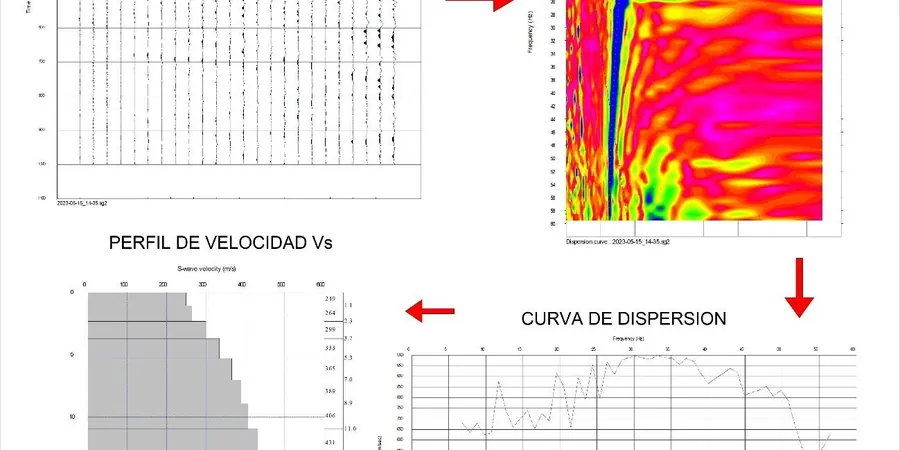
VS30 from MASW is the primary parameter for NBCC seismic site classification; a 50 m/s error can shift a Site Class D to C, altering design accelerations by 30%.
Scope of work in Gatineau
Typical technical challenges in Gatineau
In Gatineau's Plateau sector, stiff glacial till over bedrock yields VS30 values above 600 m/s (Site Class C), whereas along the Rivière des Outaouais floodplain the soft silty clay drops velocities below 250 m/s (Site Class E). This twofold difference means a building designed for the Plateau could suffer amplified shaking and potential liquefaction if built on the floodplain without proper site-specific MASW data. Many structures in the old Hull district were built before the 2005 NBCC seismic provisions; retrofitting them requires reliable VS30 profiles to avoid over-conservative — and expensive — strengthening measures.
Our services
Our complete MASW and VS30 service package includes field acquisition, inversion, and reporting tailored to Gatineau's geological context.
Active-Source MASW Survey
24-channel acquisition with sledgehammer or accelerated weight drop; ideal for depths up to 40 m in residential and commercial sites. Includes dispersion curve picking and 1-D inversion.
Passive Microtremor Array (ReMi)
Ambient noise recording with circular or linear arrays to resolve low-frequency dispersion at deeper bedrock interfaces. Essential for sites with thick Champlain Sea clay.
VS30 Site Classification Report
Certified VS30 value with NBCC Site Class assignment, uncertainty analysis, and comparison to adjacent borehole data. Delivered in PDF + digital spreadsheet format.
Integrated MASW + CPT Interpretation
Combined geophysical and geotechnical interpretation for liquefaction triggering assessment per Youd-Idriss (2001) and NCEER guidelines. Includes joint profiles of Vs and cone resistance.
Frequently asked questions
What is the typical cost of a MASW / VS30 survey in Gatineau?
For a standard MASW survey with inversion and NBCC site classification report, costs range between CA$2.180 and CA$4.220 depending on array length, number of profiles, and site access conditions. Volume discounts apply for multi-profile developments.
How deep does MASW investigate in Gatineau's Champlain Sea clay?
With a 48 m active spread and a low-frequency sledgehammer source, we reliably image to 25–35 m depth in soft clay. For deeper investigation (up to 60 m), we use passive microtremor arrays with 50–100 m aperture. The clay's low shear wave velocity (100–250 m/s) actually improves depth penetration because longer wavelengths are generated.
Is MASW accepted by the City of Gatineau for building permit seismic requirements?
Yes. The City of Gatineau's building department accepts MASW-derived VS30 as the primary method for NBCC site classification, provided the survey follows ASTM D4428 and the report is signed by a Professional Engineer licensed in Quebec. We have submitted over 40 MASW reports for permits in Gatineau since 2020.