Too often, contractors in Gatineau begin excavation work near the Gatineau River or along the Laurentian escarpment without real-time data on soil behavior, relying instead on pre-construction borehole logs that quickly become outdated. When pore pressures shift unexpectedly during spring thaw or after heavy rainfall, the lack of continuous monitoring can lead to wall movement or surface cracking that could have been prevented. Geotechnical instrumentation design and installation bridges that gap by deploying piezometers, inclinometers, and settlement cells that transmit data directly to the engineer. Integrating this with a MASW Vs30 survey helps correlate shear wave velocity profiles with instrument readings, giving a complete picture of subsurface response under load.
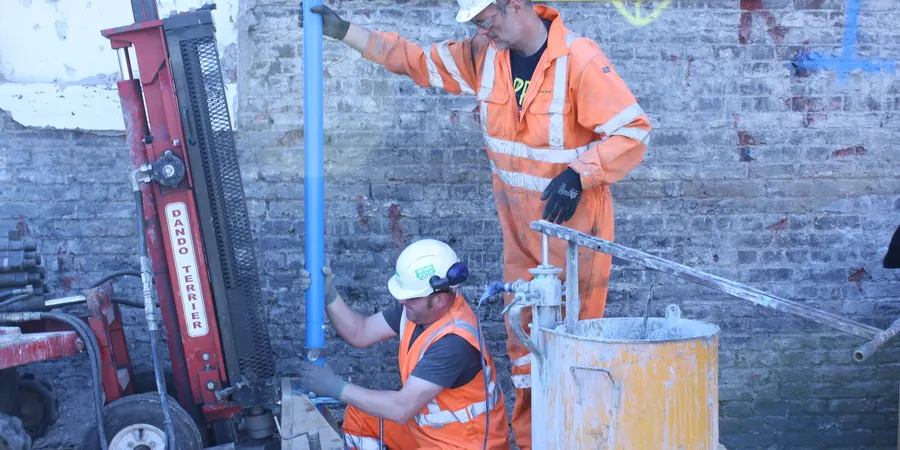
Real-time data from piezometers and inclinometers reduces uncertainty in Gatineau's sensitive clay formations, preventing costly mid-construction surprises.
Scope of work in Gatineau
Typical technical challenges in Gatineau
Setting up an inclinometer casing in Gatineau's soft Champlain Sea clay requires careful grouting to avoid voids that skew readings. If the annulus is not backfilled with a low-strength cement-bentonite mix, the casing may buckle during the first freeze-thaw cycle, rendering months of data useless. Our field crews use calibrated tremie pipes and verify grout density with a Marsh funnel before each lift, ensuring the casing remains vertical and bonded to the surrounding soil. Without this precision, the instrumentation becomes a liability rather than a decision-making tool, and the project loses the early-warning capability that justifies the investment.
Our services
We offer three tailored service packages for geotechnical instrumentation in Gatineau, designed to match project scale and risk profile.
Open-Pit and Excavation Monitoring
Deployment of inclinometers, piezometers, and survey prisms around deep excavations in downtown Gatineau or along the Promenade de l'Outaouais. Real-time alarms sent to site supervisors and structural engineers.
Embankment and Slope Stability Arrays
Long-term installation of settlement plates, standpipe piezometers, and tiltmeters on highway embankments or riverbank slopes. Data reviewed monthly with seasonal trend analysis.
Foundation Performance Verification
Vibrating-wire strain gauges and crackmeters on mat foundations and pile caps for commercial buildings. Baseline readings taken before concreting and monitored through the curing and loading phases.
Frequently asked questions
What types of sensors are typically used for geotechnical instrumentation in Gatineau?
Common sensors include vibrating-wire piezometers for pore pressure, in-place inclinometers for lateral displacement, and settlement cells for vertical movement. For projects on sensitive Champlain Sea clay, we also recommend crackmeters on adjacent structures and tiltmeters on retaining walls.
How much does geotechnical instrumentation design and installation cost in Gatineau?
A typical monitoring program for a mid-size excavation in Gatineau ranges between CA$3,520 and CA$5,040, including sensor supply, drilling, installation, and three months of data logging. Larger arrays with 15+ sensors and remote telemetry can exceed CA$8,000.
Do you provide real-time data access for remote monitoring?
Yes. All our installations include a web-based dashboard accessible by the project engineer and owner. Alarms can be set for threshold values — for example, if lateral displacement exceeds 5 mm or pore pressure rises above 80% of the overburden stress. Data is stored for the full project duration.