Landfill geotechnics in Gatineau demands a thorough understanding of the local subsurface conditions. Our team deploys track-mounted drill rigs equipped with continuous sampling systems to retrieve undisturbed cores from the thick Champlain Sea clay that underlies much of the region. These deposits, known for their high sensitivity and low permeability, require careful handling to avoid sample disturbance. We combine Standard Penetration Tests with advanced piezocone soundings to map stratigraphy and detect any granular lenses that could compromise containment. For sites near the Gatineau River, we integrate georradar GPR surveys to locate buried utilities or abandoned wells before drilling begins. This phased approach ensures that the geotechnical model accurately reflects the heterogeneous nature of these glaciomarine sediments.
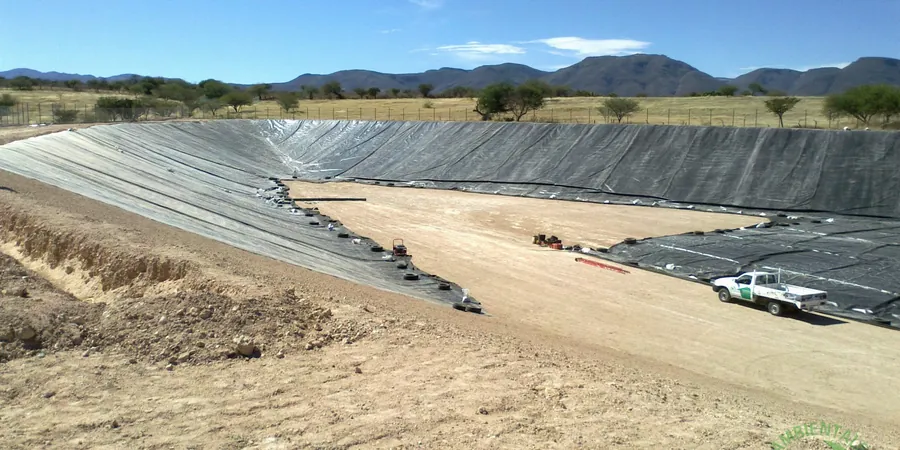
Champlain Sea clay in Gatineau provides excellent natural barrier properties, but its sensitivity demands careful excavation and compaction control to maintain long-term containment integrity.
Scope of work in Gatineau
Demonstration video
Typical technical challenges in Gatineau
A common oversight in Gatineau landfill projects is assuming uniform clay behavior across the site. We often observe localized sand seams or desiccation cracks near the surface that can create preferential flow paths. These features are easily missed if boreholes are spaced too far apart. Another risk is the sensitivity of the clay — remolding during compaction can reduce shear strength by 50% or more, leading to instability in the liner slopes. We mitigate this by specifying low-energy compaction techniques and verifying density with nuclear gauge tests at each lift. Gas migration through the cover system is also a concern; we design passive venting layers and monitor differential settlement that could tear the geomembrane.
Our services
We deliver a full suite of landfill geotechnics services tailored to Gatineau conditions, from initial site screening through to construction quality assurance.
Subsurface Characterization for Landfill Siting
Borehole drilling, SPT, and continuous core sampling to define stratigraphy, hydraulic conductivity, and bearing capacity of natural clay deposits. Includes piezometer installation for long-term groundwater monitoring.
Liner and Cover System Design Verification
Compaction control, permeability testing, and shear strength evaluation for clay liners and geosynthetic clay liners. We verify interface friction between geomembranes and compacted clay using direct shear tests.
Gas Management and Leachate Control
Design of gas extraction wells, passive venting layers, and leachate collection pipes. We model gas generation using the USEPA LandGEM model and monitor settlement with survey arrays to prevent liner damage.
Frequently asked questions
How does the Champlain Sea clay in Gatineau affect landfill liner design?
The clay provides a natural barrier with very low hydraulic conductivity, which reduces the required thickness of compacted clay liners. However, its sensitivity to remolding means that compaction must be carefully controlled to avoid strength loss. We typically specify a maximum lift thickness of 150 mm and use sheep's-foot rollers to achieve uniform density.
What is the typical cost range for a landfill geotechnics study in Gatineau?
A comprehensive study including drilling, laboratory testing, and reporting ranges from CA$2.890 to CA$10.710 depending on the number of boreholes, depth of investigation, and the complexity of gas/leachate modeling. Larger sites with multiple monitoring wells fall at the higher end of this range.
Which standards apply to landfill geotechnics in Canada?
The Canadian Council of Ministers of the Environment (CCME) provides national guidelines for landfill siting and operation. For construction, we follow ASTM standards: D1586 for SPT, D698/D1557 for compaction, and D5084 for hydraulic conductivity. The National Building Code of Canada 2020 also includes seismic design provisions for waste fills.
How do you manage gas migration risks in Gatineau landfills?
We install passive venting layers beneath the cover system and use gas wells with active extraction where methane generation exceeds 1 m³/Mg/year. The wells are spaced at 30–50 m centers, and we monitor flow rates monthly during the first two years. If differential settlement exceeds 100 mm, we retrofit with flexible gas piping.