Gatineau grew fast in the 1960s when the bridge connecting it to Ottawa sparked a housing boom. That expansion pushed construction onto terraces of Champlain Sea clay and sandy outwash plains. We see the legacy of that history every time we deploy a seismic line. The old fill, the soft marine clay, the shallow bedrock near the Canadian Shield — all of it shows up in the velocity models. Seismic tomography is essential here because the geology changes fast. A few meters can separate stiff till from soft clay. Before we set up a refraction spread, we often run a MASW survey to check the Vs30 profile and confirm our array geometry.
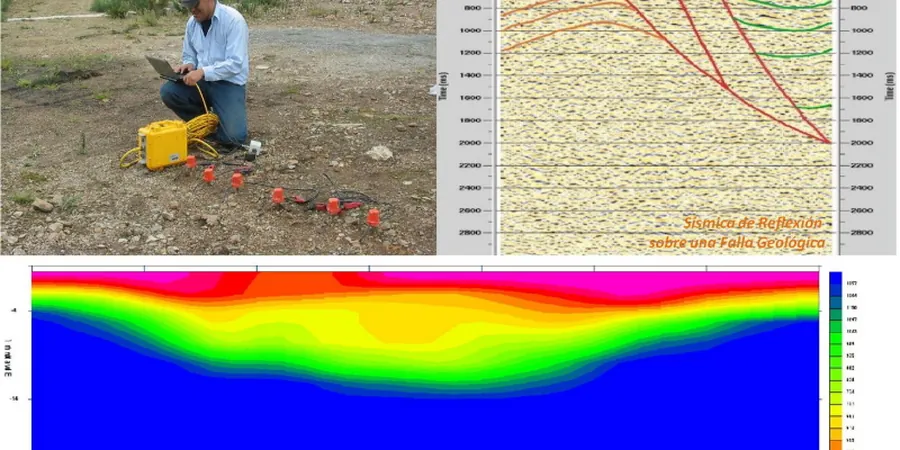
A building on Champlain Sea clay can amplify ground motion by a factor of two compared to a rock site.
Scope of work in Gatineau
Typical technical challenges in Gatineau
NBCC 2020 imposes site-specific seismic hazard analysis for buildings in Gatineau because the Ottawa Valley is a moderate seismic zone. The 2010 earthquake near Val-des-Bois reminded everyone that the ground can shake harder than expected. Our team applies the code's requirements for site class determination. We map the shear wave velocity profile to at least 30 meters depth. That data feeds directly into the design spectrum. A building on Champlain Sea clay can amplify motion by a factor of two compared to a rock site. Seismic tomography gives you the numbers to prove it.
Our services
Our laboratory offers two seismic tomography services tailored to Gatineau's geology.
Refraction tomography
Uses first-arrival travel times to build a 2D velocity model. Best for mapping bedrock depth and layer boundaries in soft ground.
Reflection tomography
Records reflected wave arrivals to image deeper structures. Ideal for detecting faults or buried channels beneath the Champlain Sea clay.
Frequently asked questions
What is the difference between refraction and reflection tomography?
Refraction measures the first wave that arrives at each geophone, traveling along layer boundaries. It works best for mapping shallow interfaces like the clay-till contact. Reflection records waves that bounce off deeper layers, like bedrock fractures or buried channels. In Gatineau we often run both to get a complete picture.
How deep can seismic tomography see in Gatineau?
Refraction reaches about 35 meters with a 72-meter array. Reflection can go deeper, up to 50 meters, depending on the source energy and soil conditions. The soft clay of the Ottawa Valley transmits waves well, so we get good signal even at depth.
How much does seismic tomography cost in Gatineau?
The reference range for a standard 72-meter refraction line is CA$3.910 to CA$6.640. Reflection adds about 30% due to the extra processing. Volume discounts apply for multiple lines. Contact our lab for a quote tailored to your site.
Do I need seismic tomography for a residential project in Gatineau?
NBCC 2020 requires site-specific seismic data for buildings with a seismic importance factor greater than 1.0. For a single-family home on rock, usually not. For a duplex or commercial building on Champlain Sea clay, yes. The tomography data avoids overdesign and saves money on foundations.