The contrast between the clayey plains of Gatineau's Plateau sector and the sandy terraces of Aylmer illustrates why a one-size-fits-all foundation approach fails here. In the Plateau, thick Champlain Sea clay deposits can settle several centimeters under moderate loads unless preloaded or improved, while Aylmer's granular soils drain freely but may need compaction control to prevent differential movement. Our soil mechanics study in Gatineau targets exactly these variations, combining field borings with advanced lab testing to match the real ground conditions. We have seen projects where ignoring the plasticity of local marine clays led to slab heave within two years, reinforcing the value of thorough characterization before breaking ground.
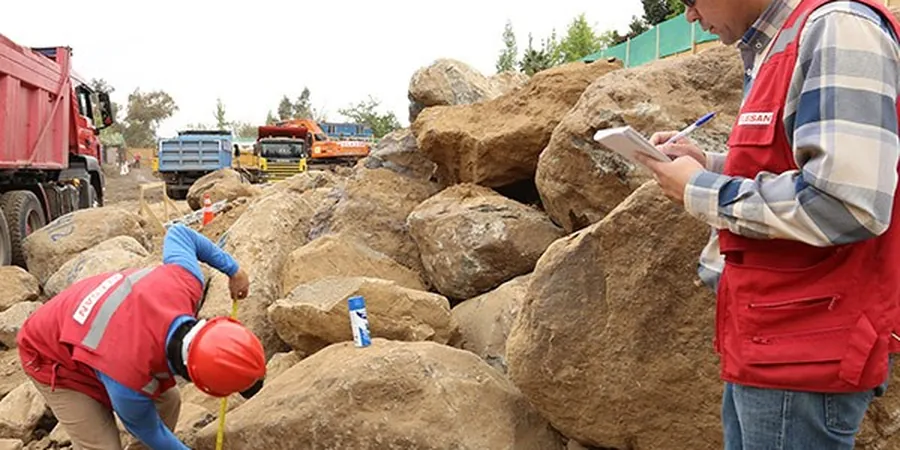
Champlain Sea clays under Gatineau can lose 50% of their strength when saturated — our study quantifies that risk before your foundation is poured.
Scope of work in Gatineau
Demonstration video
Typical technical challenges in Gatineau
Gatineau sits within a moderate seismic zone (NBCC 2020 Sa(0.2) ≈ 0.4–0.6 g), and the underlying Champlain Sea clays are susceptible to strength loss under cyclic loading. A soil mechanics study in Gatineau must therefore evaluate liquefaction potential even for sites away from the river, because loose saturated silts and fine sands exist in buried channels. We have documented cases where shallow foundations on untreated clay experienced 30–50 mm of settlement after a magnitude 5.1 event near Val-des-Bois. Our study includes cyclic triaxial tests when the plasticity index falls below 12 and the water table is within 6 m of grade, giving designers the data needed to specify deep foundations or ground improvement.
Our services
Our soil mechanics study in Gatineau covers the full scope from field exploration to certified lab reports. We deliver actionable parameters for foundation design, slope stability, and pavement subgrade evaluation.
Borehole Drilling & SPT
Continuous split-spoon sampling with SPT at 1.5 m intervals, providing N-values and undisturbed samples for lab testing.
Laboratory Classification
Grain size analysis, Atterberg limits, and moisture-density relationships to classify soils per USCS and AASHTO.
Triaxial & Direct Shear Testing
UU, CU, and CD triaxial tests plus direct shear to determine peak and residual strength parameters for design.
Geotechnical Report & Recommendations
Comprehensive report with bearing capacity, settlement estimates, seismic site class, and foundation alternatives.
Frequently asked questions
How long does a soil mechanics study in Gatineau typically take?
For a standard residential lot with 2–3 boreholes, field work takes one day and lab testing another 5–7 business days. Commercial sites with deeper borings or specialized triaxial cycles may require 2–3 weeks total.
What is the difference between a soil mechanics study and a simple soil test?
A simple test might give you a bearing capacity number based on visual classification. Our study includes SPT, strength testing, consolidation parameters, and seismic site classification — enough data for an engineer to design foundations that comply with NBCC 2020.
Do I need a soil mechanics study for a basement renovation in Gatineau?
If you are underpinning walls or adding a lower level in the Plateau sector where clay is deep, yes. The municipal permit often requires a geotechnical letter confirming that excavation will not undermine adjacent structures or cause settlement.