Gatineau sits on a mix of stiff Leda clay and glacial till, with pockets of soft sediments along the Ottawa River. These layers can amplify seismic waves significantly, especially during a magnitude 6+ event from the Western Quebec Seismic Zone. We measure shear-wave velocity profiles using MASW and HVSR to classify site class per NBCC 2020. Each project starts with a field reconnaissance to map soil layering and groundwater depth. For sites with thick soft clay, we combine this analysis with a MASW-Vs30 survey to capture velocity contrasts at depth. The results feed directly into dynamic soil-structure interaction models.
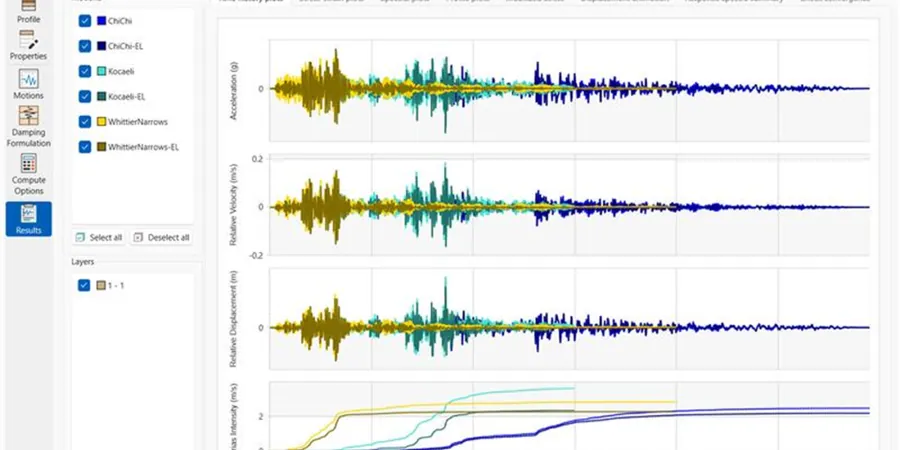
Soft Champlain Sea clay in Gatineau can amplify ground motions by 2-4 times compared to bedrock, demanding site-specific response analysis for code compliance.
Scope of work in Gatineau
- Vs30 and site class (A through F)
- Fundamental site period (T-site)
- Amplification factors for short and long periods
- Liquefaction triggering potential (Youd-Idriss, 2001)
Typical technical challenges in Gatineau
A portable seismograph array is deployed across the site to record ambient vibrations and controlled-source signals. In Gatineau, winter frost and high water table can delay deployments and skew readings if sensors freeze. We schedule fieldwork during dry summer months and use heated enclosures for cold-weather jobs. The biggest risk is misclassifying a site as Class C when it's actually Class D due to hidden soft layers. That error underestimates design forces by up to 30%. We cross-check each Vs profile with borehole logs to avoid this.
Our services
We provide two complementary seismic amplification services tailored to Gatineau's soil conditions.
Site-Specific Response Spectra
Development of elastic and inelastic response spectra using equivalent-linear and nonlinear ground response analysis. Includes Vs30 profiling, site classification, and amplification factors per NBCC 2020.
Liquefaction Triggering Assessment
Evaluation of cyclic stress ratio (CSR) and cyclic resistance ratio (CRR) using SPT and Vs-based methods. Identifies zones of high liquefaction susceptibility in loose sands and sensitive clays.
Frequently asked questions
How does seismic amplification analysis differ from a standard geotechnical investigation?
A standard investigation focuses on bearing capacity and settlement. Seismic amplification analysis specifically evaluates how local soil layers modify earthquake ground motions. It uses shear-wave velocity profiles, dynamic soil properties, and site response modeling to produce design spectra for structural engineers.
What site classes are most common in Gatineau?
Most of central Gatineau sits on stiff clay and till, corresponding to NBCC Site Class C or D. Areas near the Ottawa River and floodplains have softer clay (Site Class E), which requires higher amplification factors. Bedrock outcrops in the northern hills are Class A or B.
What is the typical cost range for a seismic amplification study in Gatineau?
For a standard residential or low-rise commercial site, the cost ranges from CA$1,260 to CA$2,490. This includes field work (MASW or HVSR), lab testing, site response modeling, and a report with design spectra. Larger or complex sites may exceed this range.
Do you comply with NBCC 2020 for seismic design?
Yes, all our analyses follow NBCC 2020 Division B Part 4, including the 2025 seismic hazard model updates. We provide site-specific response spectra that replace the generic code spectra, ensuring your design meets or exceeds national standards.