Gatineau sits on the Ottawa-Bonnechere Graben, a region with moderate seismic activity. The city's geology is dominated by Leda clay and Champlain Sea deposits. These sensitive marine clays can lose strength under cyclic loading. For any structure in Gatineau, seismic foundation design must address soil liquefaction potential and site amplification. We integrate NBCC 2020 seismic hazard maps with local borehole data. This ensures foundations resist both static and dynamic loads. Before design begins, we recommend a MASW-Vs30 survey to measure shear wave velocity profiles and classify the site class.
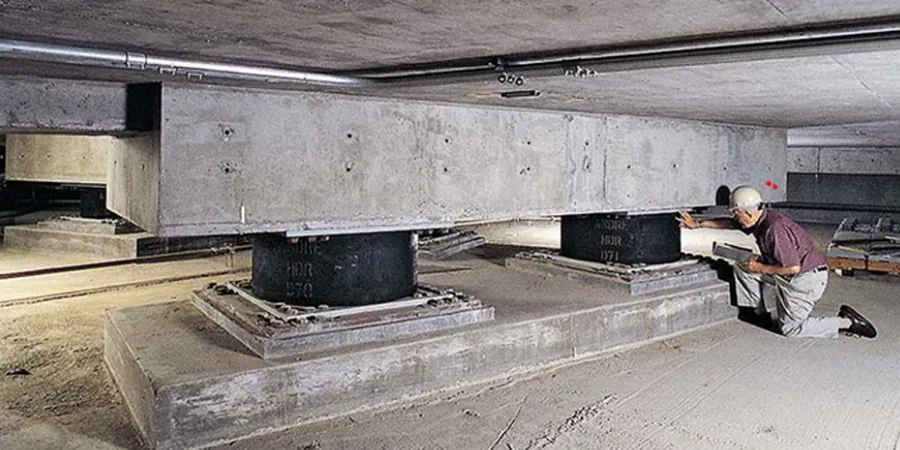
Gatineau's Leda clay can lose 50% of its shear strength under cyclic loading — seismic design must account for this.
Scope of work in Gatineau
Typical technical challenges in Gatineau
The freeze-thaw cycle in Gatineau's winters exacerbates soil cracking and drainage changes. Spring thaws saturate the upper clay layers, increasing pore pressure. During an earthquake, this elevated pore pressure can trigger liquefaction in sandy lenses within the clay. Our seismic foundation design evaluates seasonal moisture effects. We model the foundation under both summer and winter ground conditions. This prevents unexpected failure during a seismic event when the ground is saturated.
Our services
We offer two specialized sub-services for seismic foundation design in Gatineau:
Seismic Hazard Analysis and Site Response
Deterministic and probabilistic seismic hazard analysis using NBCC 2020 ground motion models. Includes site response analysis with SHAKE or DEEPSOIL to compute surface acceleration spectra. Output includes design spectra for elastic and inelastic response.
Foundation Performance Verification
Nonlinear pushover analysis of shallow and deep foundations under seismic loads. We evaluate bearing capacity, sliding, and overturning using LRFD principles. For critical structures, we perform 3D finite element modeling in PLAXIS or FLAC.
Frequently asked questions
What is the cost range for seismic foundation design in Gatineau?
The typical cost for a seismic foundation design study in Gatineau ranges from CA$1,750 to CA$5,980. This includes site classification, hazard analysis, and foundation recommendations. Complex sites with deep clay or liquefaction concerns may reach the higher end.
Does Gatineau require seismic design for all buildings?
Yes, the NBCC 2020 requires seismic design for all buildings in Gatineau. The seismic hazard is classified as moderate. Buildings in Importance Category III and IV (schools, hospitals, emergency centers) require a site-specific seismic hazard analysis regardless of soil conditions.
How does Leda clay affect seismic foundation design?
Leda clay is highly sensitive and can lose strength rapidly when disturbed. Under cyclic loading from an earthquake, it may undergo strain softening. We perform cyclic triaxial tests to measure the degradation curve. Foundations must be designed with reduced bearing capacity and increased reinforcement to accommodate potential strength loss.