Gatineau sits on the Ottawa-Bonnechere Graben, a region with deep glacial till and sensitive Leda clay. These deposits can reach over 30 meters in thickness near the Ottawa River. For any deep excavation, understanding the soil profile is not optional, it is a safety requirement. A proper geotechnical design of deep excavations in Gatineau starts with a site-specific investigation that targets the exact stratigraphy. Our team combines field data from calicatas exploratorias and laboratory testing to model behavior under excavation loads. This early step prevents costly surprises during shoring and dewatering.
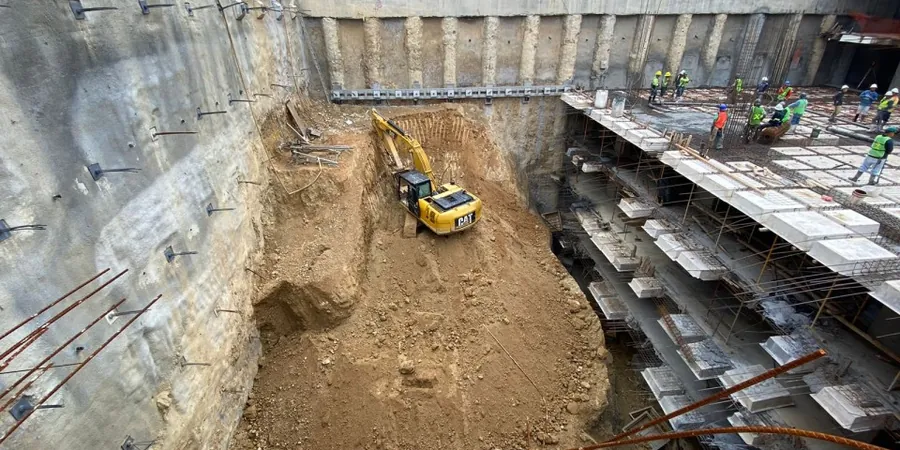
Leda clay in Gatineau can lose 50% of its undrained shear strength when remolded. That changes everything for temporary works design.
Scope of work in Gatineau
Typical technical challenges in Gatineau
Compare the Hull sector near the river with the Aylmer plateau. In Hull, thick soft clay and high water table dominate. In Aylmer, you find stiffer glacial till and lower groundwater. A design that works in Aylmer may fail in Hull. The greatest risk in Gatineau is basal heave in deep excavations through soft clay. Without proper factor of safety against bottom instability, the excavation floor can lift suddenly. Our geotechnical design of deep excavations in Gatineau always includes a basal heave check using Bjerrum and Eide methods. We also verify that the wall embedment depth is sufficient to prevent piping in pervious layers.
Our services
We offer two core services tailored to deep excavation projects in Gatineau.
Shoring and Earth Retention Design
Complete design of soldier pile and lagging, sheet pile, secant pile, and diaphragm walls. Includes lateral earth pressure calculation, wall deflection analysis, and tieback or strut design per NBCC and CSA standards.
Dewatering and Groundwater Control
Hydrogeological assessment for deep excavations. We design wellpoint systems, deep wells, or cut-off walls to control groundwater inflow. We also evaluate the risk of settlement due to dewatering in adjacent structures.
Frequently asked questions
What is the typical cost range for geotechnical design of deep excavations in Gatineau?
The cost typically ranges from CA$2,860 to CA$11,840 depending on excavation depth, soil complexity, and the number of field tests required. Contact us for a project-specific quote.
What soil conditions are most challenging for deep excavations in Gatineau?
The sensitive Leda clay is the most problematic. It has high natural water content, low remolded strength, and can lose shear strength quickly when disturbed. High water table in the Hull sector also adds complexity.
Which building code governs deep excavation design in Gatineau?
The National Building Code of Canada (NBCC 2020) sets the minimum requirements for geotechnical design. Additionally, CSA A23.3-19 applies for concrete elements, and ASTM standards govern field and lab testing methods.
How do you monitor excavation walls during construction?
We install inclinometers, piezometers, and survey targets. Data is collected in real time and compared against trigger levels defined in the design. This ensures the wall behaves as predicted and allows early intervention if needed.
Do you provide dewatering design for deep excavations in Gatineau?
Yes. We design wellpoint systems, deep wells, and cutoff walls based on site-specific permeability tests. We also evaluate the risk of consolidation settlement in adjacent buildings caused by groundwater drawdown.