A six-storey residential building along Boulevard des Allumettières was stalled after the geotechnical report showed variable compaction in the granular base. Our team mobilized a 600 mm diameter plate and a 30-ton hydraulic jack to run a plate load test directly on the prepared subgrade. The test followed ASTM D1196-12, with three loading cycles and settlement readings every 30 seconds. We obtained a bearing capacity of 280 kPa at 25 mm settlement, allowing the structural engineer to finalize the footing design. In Gatineau, where glacial till and river sediments alternate within short distances, the plate load test provides a direct, in-situ measurement of soil stiffness and load-settlement behaviour that laboratory tests alone cannot replicate.
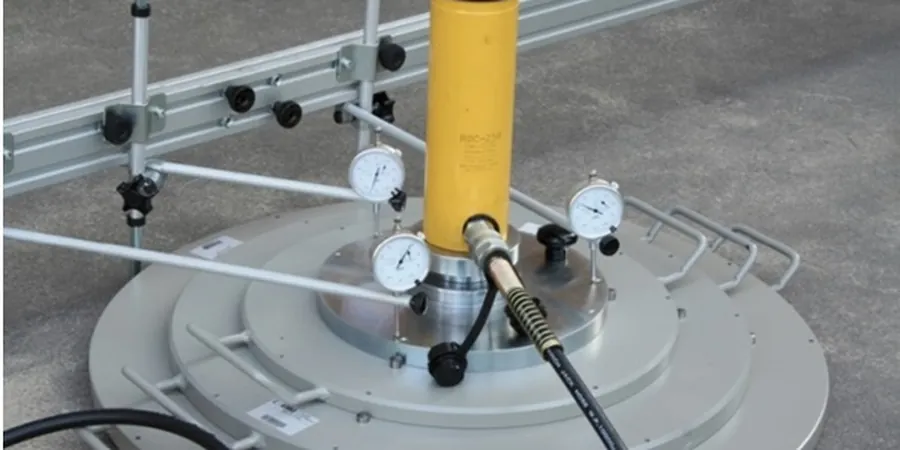
A plate load test delivers the actual load-settlement curve of the foundation soil under real stress conditions, not an estimate from tables.
Scope of work in Gatineau
Typical technical challenges in Gatineau
Leda clay in Gatineau is highly sensitive and can lose strength when disturbed. A plate load test on this soil must be performed on an undisturbed surface, with careful excavation to avoid remolding. The high water table near the Ottawa River (often within 1–2 m of the surface) can cause rapid settlement under load if drainage is insufficient. We always check the groundwater level before testing and, if necessary, install a temporary well point to lower the phreatic surface. Without this precaution, the test results may overestimate the actual bearing capacity of the foundation soil.
Our services
We offer two standard configurations for the plate load test in Gatineau, adapted to the project scale and soil type.
Standard PLT for Shallow Foundations
Using a 600 mm plate and a 50-ton hydraulic jack, we apply incremental loads up to the design bearing capacity or until 25 mm settlement. Suitable for footings, mat foundations, and slab-on-grade in residential and commercial buildings.
PLT for Pavement and Subgrade Evaluation
We use a 300 mm plate for thinner pavement layers, measuring the k-value for flexible pavement design. The test is performed on the prepared subgrade and on each subsequent base course to verify compaction quality.
Frequently asked questions
What is the difference between a plate load test and a CBR test?
The plate load test measures in-situ bearing capacity and settlement under a static load, using a plate of known diameter. The CBR test is a laboratory penetration test on compacted soil samples. PLT gives direct field data; CBR is used for pavement thickness design. Both are complementary, but for foundation design in Gatineau, PLT is preferred for shallow footings.
How deep does the plate load test evaluate the soil?
The influence depth of a plate load test is approximately 1.5 to 2 times the plate diameter. For a 600 mm plate, that means the test evaluates the soil to about 0.9–1.2 m depth. This is sufficient for shallow foundations, but for deeper bearing layers, we recommend complementary methods such as the ensayo SPT.
What is the typical cost of a plate load test in Gatineau?
The reference range for a plate load test in Gatineau is CA$1,220 – CA$1,880 per test point, including mobilization, setup, three loading cycles, and a written report. Additional points, remote sites, or special plate sizes may adjust the price. Contact our team for a quote tailored to your project.
When should I order a plate load test instead of relying on soil classification alone?
Soil classification (grain size, Atterberg limits) tells you what the soil is, but not how it will behave under load. A plate load test is essential when the design bearing capacity must be verified in situ, especially for fills, compacted subgrades, or variable soils like the Champlain Sea deposits in Gatineau. It eliminates the uncertainty of table-based estimates.